- The groundstroke take back is a chain reaction motion in all 3 planes.
- The transformational zone is a vital component in a chain reaction.
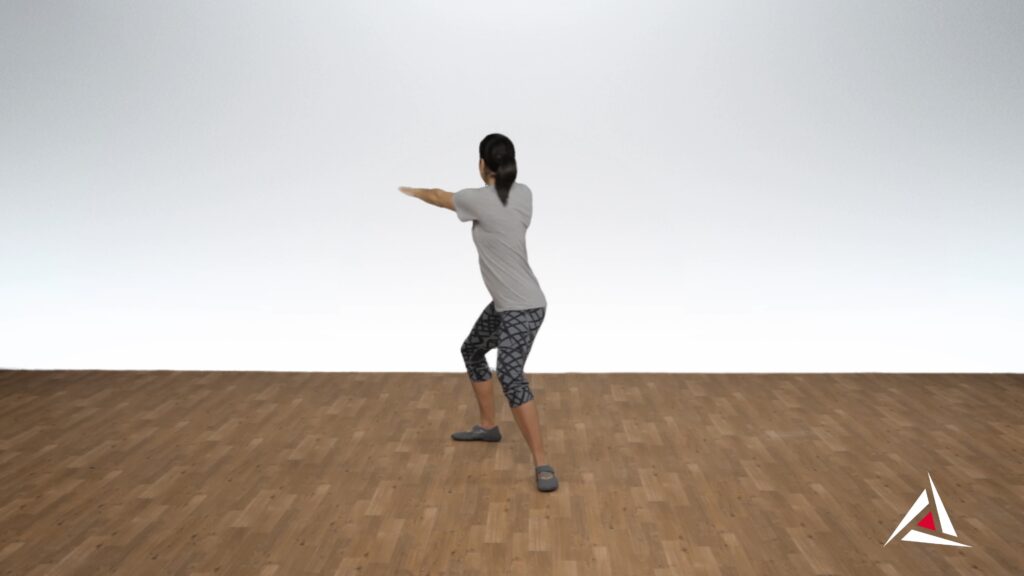
I want to illustrate how the joint motions in the chain accomplish the movement in the take back efficiently whatever style you use, Classic ATP, Next Gen, or any other hybrid like Alcaraz. The take back is a chain reaction from the ground up:
Consider this syllogism:
- All human movement in upright function is a chain reaction.
- The take back is a human movement in upright function.
- Therefore the take back is a chain reaction.
It’s deductive reasoning, but for those empiricists among you read on.
The Take Back
I don’t see how an early and/or expansive arm movement in the take back will create either more efficient preparation or result in extra speed in the stroke.
It’s the whiplash or ‘flip into the slot’ which occurs towards the end of the take back, in the transformational zone of the whole chain reaction, as the take back becomes the forward swing. It’s where meaningful acceleration begins. More on this in part 2.
Let’s look at the initial stages of the take back first which you can see in Tom’s split step/turn. He is holding the racket at the throat as a teaching method not a technique as it encourages him to avoid the arm driven motion which he wants to change:
And Justine’s split step landing with turned foot:
Moving further up the chain look at the trunk and shoulders which have turned to the side as a result of the right foot turning out and note where Tom’s arms and racket are at this point:
and compare it to the original position of his feet:
and how that affects the complete swing in his previous arm driven action:
Now see how his take back is driven by the chain reaction in his trunk turning it backwards before the right shoulder and arm complete that turn (loading) before transforming it into an explosive forward swing. The left arm and shoulder are also part of the chain driving the movement forwards:
The fastest part of the swing is in the contact zone where it should be and shows as a blur in the clip as it does with me in this clip from a few years ago:
It’s the acceleration from the transformational zone to the contact zone as the racket head becomes a blur indicating speed.
I have shown you that the take back is driven in large part by the same side rotational motion moving up the chain creating the trunk turn with little independent arm movement. Independent arm movements contribute less to its effectiveness and are therefore a matter of preference.
Train the take back with the SSR Chain Reaction
Accepting that premise how can we learn/train that chain reaction?
Tom did it by repetition in training using the matrices from 3DMAPS for all six chain reactions. We emphasized the SSR (same side rotational )chain slightly more as it can be tweaked more easily to mirror the forehand take back.:
Tom warms up with lunge matrix in the six more common directions of the three planes and a collection of tweaks like the pivot. There are numerous other chain reactions and hybrids of these six you can train which meet the demands of your sport and any other purposeful activity.
However, the essential element in the 3DMAPS exercise process is creating the proprioceptive pathways by repeating them for the six chains to build your initial or base capacity and adding to it for your specific activity and to expand your overall movement range.
Your Range of Motion
All the mobility matrices in 3DMAPS, of which some are shown above, enable each individual to experience motion at their initial range through to their end range at all the joint complexes. The objective of 3DMAPS is both to expand an individual’s range of motion and to ensure that those individuals operate efficiently and safely at their current mid-range with buffers in extremis. You can see this as the same side rotational lunge goes a lot further round than you would need for a tennis take back..
Nobody can operate at end range, no matter how large that range is, without risking injury, a fact borne out by so many of the ‘Next Gen’ players on tour.
1. The Take Back. Conclusion
These videos and countless others illustrate clearly that the first part of the take back is driven by the motion of the trunk which is mostly driven up the chain from the action of the feet below. The eyes and arms are secondary drivers at this point.
Whether the racket face is vertical or horizontal or on the diagonal (Alcaraz) seems less important to me in determining the most efficient take back..
It’s the pull/push of the swing generated by this continuing chain reaction in the body, which allows the racket head to drop ‘The flip into the slot in tennis speak’ and complete the take back, and transform into an explosive move forward to contact.
2. The transformational zone
The initial transformation zone in the take back is at the right hip when the motion reaches full excursion and a fully loaded hip starts to turn forwards driving the shoulder and the arm back into their transformational zone. (See Justine in the video above). We experience the transformational zone in all our movements when motion in one direction to load transforms to another to explode. Think jumping, you sink down to load to explode upwards. There is a lot more to say on this in further posts.
In this last clip, I demonstrate how I apply these AFS principles in my group coaching and how you can translate complex principles of human movement into simple training and coaching tools for players of all ages and abilities:
Vaughan Ebrahim, LTA Level 4. GI. CAFS 2013, 3DMAPS 2017, FGS 2023