In my previous posts on Fascia describing what it is and attempting the explain what it does I have ommited to mention the operating system and how it differs from our traditional understanding based on Newtons lever system. The implications for how we train are clear when we consider these differing systems and I think will clarify so many things in human movement that Newtons theory failed to satify. The move to whole body exercises in fitness regimes has been developing over the last two decades or more and it is only now that we can begin to understand why. If our bodies operate as a chain reaction in movement, and not a lever system, why is that? What connects the parts? What is the most efficient training method, training the parts or the whole?
What levers do
Muscles and bones act together to form levers. A lever is a rigid rod (usually a length of bone) that turns about a pivot (usually a joint). Levers can be used so that a small force can move a much bigger force.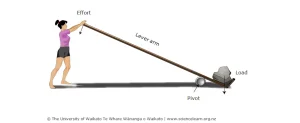
The Alternative
I am working through Bill Parisi’s book “Fascia Training: A whole system approach” and found some of the clearest explanations, some of which I cannot do better than quote.
“The human body is a unique biological organism that has evolved (*been designed) specifically to harness power from a universe in constant motion where gravity is king.” * There is no evidence that complicated systems can evolve, they must be designed in my understanding of Cosmos.
He goes on to discuss Newton’s three laws of classical mechanics and makes the point convincingly that the levered systems, as above, that have fulcrums and pivot points which operate in a single plane of motion cannot account for what we see and experience in human movement at every level of complexity in babies right upto exceptional athletes. There must be something else. He claims we operate more like plants than machines, and that this understanding suggests a more natural, whole system approach to understanding athletic performance than we have traditionally used. Newton’s Laws are best for mechanical processes but the human body operates according to biological laws. A critical difference is that human bodies self-assemble using a chemically responsive process that continually adapts to it’s environment, with it’s balanced polarity of push and pull forces. ‘This is enabled by the fascia system: the collagen and fluid -based matrix of elastic connective tissue surrounding all your muscles, organs and suspending the structural framework of your bones together in a state of balanced tension like a Tensegrity Model’
A Tensegrity System(tension+integrity)
It’s is an architectural model that allows one to create stable but adaptable structures using a balance of tension and compression. While these architectural structures can move a small amount through expansion joints they are not living moving humans! So what is the relevance. It’s in the construction of solid struts held in compression and in tension by a network of pretensioned cables
Buckminster Fuller Tensegrity – Search Images

How does it work?
According to the principle of biotensegrity, developed by Dr Stephen Levin, components float in a sea of balanced tension without touching each other. When a body is deformed by a force from the outside, the tension is spread over the entire area and affects not only locally where the force hits. The influence of strain over a long period of time can have the same effect.
In simple terms, it is a system in which hard parts, such as skeletons, and soft parts, such as collagen strands (connective tissue), work together by absorbing, distributing, and releasing pressure and tension.
The skeleton is not, as previously thought, the gallows on which everything depends. The skeleton is rather the blunt braces that the fascia attaches to and that are stabilized by the connective tissue structures. See the needle tower in the attached.
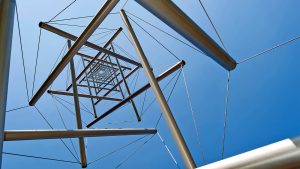
However, the body is not as static as the tower in the picture. This is because the body’s wires, the fascia, are not two, five or ten in number, but many many more. Some are tense and some are limp and they tense and relax with every movement.
You can describe it as the skeleton floating freely in the fascia. If the soft tissue is crooked, the skeleton will end up crooked. If we work to restore and maintain the soft parts, muscles and connective tissue, we can maintain a slightly free feeling, as the skeleton floats freely inside these complex structures.
Parisi says “Bones provide the struts of the tensegrity system by constantly pushing out, while muscles and connective tissues provide the elastic center-seeking pulling force. The bones never really touch and the body is an interconnected lever-less organism that adjusts to varying amounts of force and movements by distributing stress across the entire system.” He adds “We are highly integrated, electrically activated, movement-enabled bio structures that are held together in a state of stable yet flexible tension that is largely enabled by our bodÿ’s viscoelastic fascia system.”
If any of you are wondering about this new movement science and are a little sceptical about the claims, the comment that ” it’s essentially a sealed hydraulic system that functions only when you are alive” should address why it’s a recent medical advance. Previously our knowledge of anatomy and function was based on dissection of corpses and not on the imaging of living bodies we have today.
Bill Parisi founder of the Parisi Speed School has spent a considerable time meeting with the top experts in this field, exploring the science and developing the applications for training for his sport, sprinting as well as all other sporting activity and I will addressing some of these in my next vlog. His book. Fascia Training: A whole system approach is widely available.
I’ve attached a playlist of Footwork which should help you to see the fluidity in human movement which a lever system would seem unable to deliver.
So the question is still should we train the parts or have a whole system approach ?
https://www.youtube.com/watch?v=rrI_JpU_LDo&list=PL_VqiPsUEuCGJqeZzQPXdYjOCUWSlD888&index=2
I