In this blog , I will quote Fascia Industry leaders to explain Fascial Lines in terms of, what they are and what they do in Human Movement as distinct from other important roles they have in our bodies.
What they are;
They are variously described as myofascial meridians, musculofascial chains and by Tom Myers in his Book Anatomy Trains as follows:
”The basic hypothesis of Thomas Myers’ writings on Fascia kinetic lines is that muscles, no matter what they do individually, also affect tissues throughout the entire body through Fascia based interconnections.
These interconnections can be called Fascia lines and can be followed by the body’s dissectible “meridians” of connective tissue structures. They consist of membranes and ligaments, both superficial and deep connective tissue, in loose and tight form.
These Fascia lines create stability, resistance, power, flexibility, elasticity, and above all- compensatory posture. So connective tissue structures work in sync, creating a fluid and balanced movement and a posture that maintains balance and direct contact between all body parts.
In Myers book “Anatomy Trains” ligaments are described as the “inner bag” and outside them are Fascia based pathways, lines, interconnected longitudinal structures that distribute power and compensation.
The map of Fascia lines shows the longitudinal bands and loops of connective tissue including muscles and organs, which is based on the relatively new anatomical knowledge and analysis of how the musculoskeletal system really works.
The old view of muscles, the theory of “isolated muscle function” is that muscles only work between attachment and origin and mostly contracts and resists during extension. If we add on the knowledge of the Fascia’s power transmitting function, the picture is much more complex.
All tissue in the body is naturally linked to the network that the Fascia forms, but these lines are more clearly distinguishable from other tissue and appears to transmit signals / operating with more power through these pathways.”
While it’s good to know and try to understand the science it’s not essential for Fascia training. What is essential is that you begin to see the body as a connected whole and understand that, if you want to train it for whatever desired outcome, you must have that focus, it’s a whole, connected and interconnected by fascial tissue.
pictures of facial lines – Search Images

What they do;
You can see these fascial lines highlighted in the pictures above and the following are brief descriptions of their prime roles, which are broadly either structural and/or functional. These are first 4 with the rest to follow in the next post.
Superficial back line / Superficial dorsal line
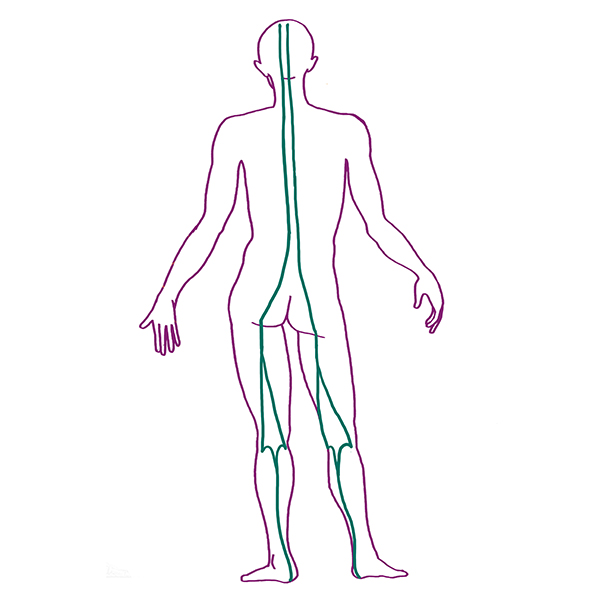
This line connects and protects the entire rear side as a back shield, from underneath the foot to the top of the skull in two parts. From toes to knees and from the knees to the eyebrows.
When the knees are extended these two parts function as a whole.
The superficial dorsal line prevents fetal position and keeps the body upright and stretched.
We are born huddled together, but with maturity and development the superficial dorsal line and its muscles are strengthened until we have a strong upright position with raised head.
A delicate point along this line is the plantar ligament under the arch of the foot. Problems here are often propagated further up the line. (So treating the foot is very good!)
To always work along the entire superficial dorsal line helps the body towards proper balance and posture.
Superficial front line

This line connects the entire front of the body from the feet to the sides of the skull in two parts. From toes to the pelvis and from the pelvis to the skull.
When the body is upright and the hips stretched the line operates as a whole integrated Fascia.
The function of the movement is to create flexion of the torso and hips, stretch the knees and dorsal flex the foot.
The need to quickly flex up the front of various joints allows this line to contain muscles with more “fast-twitch” fibers.
Here it is also important to examine carefully as the body’s reflex to huddle together and “protect itself” is strong. Traumas can cause lock ups in the superficial front line and treatment of key parts such as the sides of the neck near the ears, front axles, hip flexors and front thighs must be done properly.
This line is often the cause of the forward tilted and rotated pelvis.
Problems after whiplash and neck strain are also quite often located here, in front of the throat which constricts and compresses the cervical spine. (Scalene, sternocleidomastoid)
Lateral line
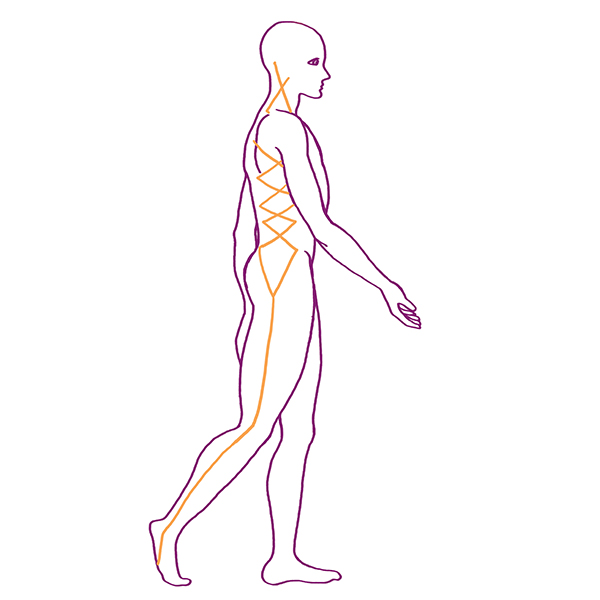
The lateral line frames both sides of the body from the foot’s center out and inside, it extends along the outside of the leg and thigh. It passes the torso in a zigzag pattern up over the shoulder and attaches close to the ear.
The line’s influence on posture is to balance the front and rear and the lateral right-left.
The line also controls the forces transmitted from other superficial lines, superficial front and back lines, all arm lines and the spiral line.
The lateral line acts to stabilize the torso relative to the legs and helps with the coordination of movement.
The line acts in a side bending manner and lifts the hips and brakes the opposite-side’s rotations and flexions.
Here, problems often occur in the “tibia band” extending on the outside of the hip and thigh. If this part becomes short and stiff it affects the hip movement negatively and movement that is supposed to be taken with the hip will instead affect the lower back by excessive lateral movement. Many times poor mobility and numbness in the thigh’s and hip’s outside can cause back pain.
Spiral line
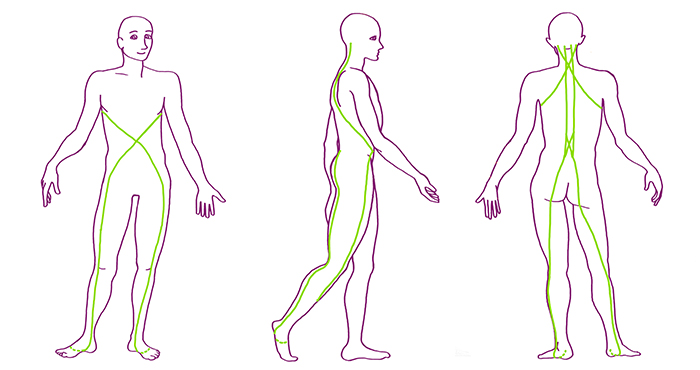
The spiral line creates a loop around the body in two opposite circles, to the right and left. It combines each side of the skull, crosses the thoracic spine back to the opposite shoulder. Then, it goes around the chest to the front to cross the navel and goes down to the hip.
From the hip the spiral line runs like a jump rope down the outside of the front thigh down to the outside of the foot. It makes a loop under the foot, continues up again towards the outer thigh more towards the rear side of the ischium. Further, onward they cross again and merge into the erector spinaes fascia.
This line stabilizes the body in all planes through its double enclosing loop. It connects the foot with the pelvis and is important in the regulation of the knee position when we walk.
When bothered this line causes rotations and imbalances throughout the body.
These lines are an integral part of maintaining structure and stability in human movement.
I will include what are collectively known as the functional lines in my next post and will also be looking at the types of exercises that will best add to your tennis workouts.
Practical Applications
My Tennis players start their warm ups with bouncing/hyperarch bounding which stimulates the foot to glute connection and will increase your ability to move and change direction quickly with dynamic balance. I do it everyday , several times a day and it gets easier over time. You can find videos on YouTube demonstrating good method.
This video demonstrates the demands on your lower limbs that playing tennis makes and injuries are usually described as muscle tears but is that neccessarily the case? When I made this video a decade + ago, although I had just started looking into fascia, I failed to understand its significance in human movement. I tried all the traditional calf strengthening exercises which took along time to work, if I had known then about fascia bouncing/hyperarch bounding!
Most Physios would still reccomend traditional methods but try bounding/bouncing/hopping as part of your daily routine to strengthen this part of the chain and avoid most of these calf strains.
Vaughan Ebrahim
LTA Level 4
Gray Institute, CAFS 20013, 3DMAPS 2017, Functional Techniques 2023