The serve, both first and second, is the first stroke in a tennis point, first chronologically but also first in terms of importance, as without it the point cannot progress. Nothing new so far, but what about dealing with the pressure this creates?
I want to illustrate, in this mini series of three vlogs, how training and coaching the body with 3DMAPS chain reaction matrices will enable the server to produce consistent serves without the pressure the mind brings in stressful situations. If trained in function the body will produce the chain reaction subconsciously. The body action is seen clearly in three phases. the load, the explode and the reload and training these three global movements in a chain reaction is the goal.
Phase 1. The load
It is undeniable that serving is the one time in tennis when you initiate the action and that will inevitably be a new dynamic with different physical and mental pressures, which need resolving. The pros deal with this by adopting a routine and a trigger move. You need a consistent routine to calm you and a trigger to initiate the loading of the body to drive the chain reaction.
Routines
Routines vary among the pros from the minimal ball bounce to the extreme Nadal sequence or even the Djokovic ball bounce which seems incessant at times. It may betray his anxiety, but also has the added effect of causing the returner to wait and maybe increase his anxiety. Whatever you decide to do it is clear that it is a process of calming and preparing to serve. Choose something easy to do and repeat and doesn’t add stress to either party.
At the end of your choice of routine your body and mind should be relaxed, no stiff arms or set determined jaw, more a relaxed stance with arms hanging loosely down like Justine’s stance:
The Trigger. The back foot load.
The trigger motion that is common to all Pros is the loading of the back foot. which harnesses ground reaction force and begins to drive the chain reaction. For Justine it is a small move onto her back foot from a slight lean forward which is simple and uncomplicated. You can copy that or a more exaggerated lean forward like Federer or go the other way, like Sampras, and start with you weight on the back foot.
The front foot load
You can choose either way, or somewhere in between for the back foot load, but the next move will still be to load the front foot which in turn drives the arm raise. Again, you can choose from a slight front foot raise like Justine as she moves onto the back foot or a more deliberate step forward onto the front foot which I’ve seen Federer use, especially when practising. This front foot move continues to drive force up the chain raising the front arm to place the ball and continue upwards to bend the back and knees:
You can see from the above that the arm continues upwards after release and drives the back and knee bend. A number of students of mine struggle with that position and try to add the knee bend at the beginning of the action. I’ve seen some old footage of Nadal’s original serve action probably from his clay court days and he starts starts with a knee bend. His service action these days is more like the Justine model and now is a force on all surfaces. My students have been told repeatedly to bend the knees but instead, should the instruction have been to continue to raise the arm after ball release to drive the body into this fully loaded position.
Does this still from the anterior chain reaction resemble some of the movements you need in the fully loaded position, like the raised arms driving the back and knee bend.
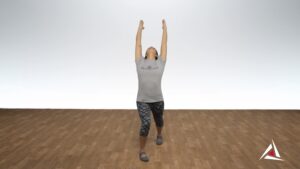
In this anterior chain reaction the body is driven into end range and with repetition you can establish this greater end range. The principle is that you establish a greater end range for a motion so that you can operate more effectively and safely at a lesser range.
Rehearsing the moves
Repetition is the key to acquiring physical skills and authentic movements, viz the old saying ‘Perfect practice makes Perfect’. For me, it’s made simpler by using the six mobility chains from 3DMAPS as your training for the global (whole) movement and then are able to tweak them for particular skill sets.
The tweaks
The front foot lunge leading to the bilateral arm raise is tweaked by using a smaller step instead of a lunge, and the arms staggered with the racket arm lagging, and by adding a move from the same side rotational chain, the body can start to turn more as it loads.
Justine’s racket arm takes this path upwards following the torso as it turns back into the fully loaded position, which you can see clearly from the different camera angles. This is the same clip to make the point:
You can see the front arm starting down to initiate the drive up to the ball from the fully loaded position which will be covered in part 2. It will deal with the ball placement arm, reversing from it’s vertical position, and starting to drive the racket arm up to the ball, which is the explode from the fully loaded position.
Join me for phase 2 soon.
Vaughan Ebrahim LTA accredited Level 4
Gray Institute, CAFS 2013, 3DMAPS 2017, FGS 2023